
Advent Candle Meanings: Three Versions Explained
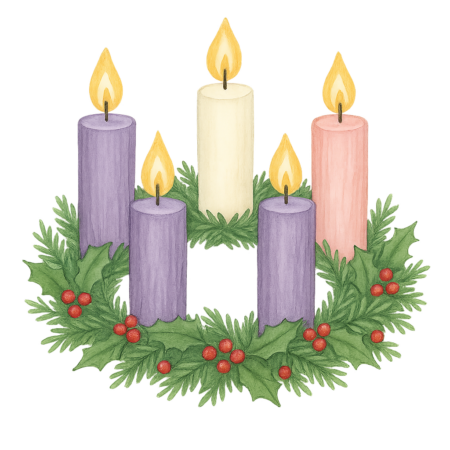
Understanding the Meanings of the Candles on the Advent Wreath One of the most beloved traditions of Advent: the Advent wreath—a simple circle of evergreens and candles meant to help us slow down and prepare our hearts for the coming of Christ. This is a great family tradition to start with kids when they are preschoolers and kindergarteners. Kids learn the meanings of the candles pretty quickly and are able to repeat them year after year. But if you’ve ever Googled “Advent candle meanings,” you’ve probably discovered something confusing: there isn’t just one answer. Different churches and families use different sets of meanings, and none of them are wrong. In fact, each one highlights a different part of the beauty of Christ’s coming. So let’s work through three separate options for you—including the story-shaped version my family has used for years. By the end, you’ll understand exactly what each candle represents, how the traditions developed, and how to find (or create) meaningful Scripture readings to use with your wreath. Quick Question: What is an Advent Wreath? If you’re new to the tradition, here’s the simple overview: an Advent wreath is a circle of evergreen branches with four candles around the outside—one for each week leading up to Christmas—and an optional center candle representing Christ. The tradition traces its origins all the way back to Johann Hinrich Wichern in 1839. The wreath is usually lit once a week, often on Sunday, with families or churches reading Scripture, praying, and reflecting together. The evergreens symbolize eternal life, and the growing light of the candles reminds us that the Light of the World is coming. Because the Advent wreath developed across different Christian traditions, the meanings of the four candles vary slightly. There has never been one universal “right” way to do it. Below are the three meaningful ways to observe them today. Advent Candle Meanings Version One: Hope – Joy – Peace – Love This is the possibly the oldest and most widely accepted interpretation of the Advent candles, especially in Protestant churches and family traditions. Each candle points to a core theme of Christ’s coming: This version is simple, beautiful, and easy to remember—perfect for families who want a traditional, gospel-focused approach with clear weekly themes. This one typically uses 3 purple candles and 1 pink candle (for Joy) along with the white Christ candle. Advent Candle Meanings Version Two: Prophecy – Bethlehem – Shepherds – Angels Another popular and meaningful version uses elements of Christ’s birth. Instead of focusing on themes, this framework focuses on events and characters in the Nativity story: Churches that follow the church calendar or lectionary often use versions of this approach. Some who use this version still use the traditional pink and purple candles, but others will use all white or red or other colors of candles. A New, Third, Candle Meanings Version: Prophets – Angels – Shepherds – Wise Men The third version is the one my family has used for years—a simple, story-shaped framework that follows the flow of the Christmas story from promise to fulfillment. We created this when our children were young because it was easy to remember, rooted in Scripture, and connected Christmas to the gospel, not just the manger. Here is what each candle represents: This version moves through the Nativity in a way children grasp instantly, yet it carries rich theological depth for adults. It begins with promises, moves through proclamation and witness, and ends with worship—showing the fullness of who Jesus is. Finding Readings for Different Advent Candle Meanings One of the most confusing parts of Advent is discovering that there’s no official, universal set of candle readings. Different churches, traditions, and devotional guides choose different Scriptures based on which set of meanings they use. Even the Catholic Lectionary follows a three-year cycle, meaning the readings change each year. The good news?This gives your family freedom to choose Scripture that fits the candle theme you’re using—whether traditional, narrative, or the story-shaped version above. Scriptures should be chosen prayerfully, but you are free to choose and reuse scriptures to meet your needs. If you want ideas or a place to start, here are a handful to get you started. Trusted Sources for Advent Candle Readings Free Download: Weekly Advent Readings If you want something simple and ready to use, I created a free one-page printable that pairs beautifully with the story-shaped version my family uses. It includes: Since the Prophets/Angels/Shepherds/Wise Men version doesn’t appear anywhere else online, this printable gives you a meaningful, easy-to-follow guide without needing to hunt down verses or mix and match your own. You can download the free printable for free in the shop. How to Use This In Your Home If you’re new to the tradition and you’re worried about doing it “right,” again there isn’t just one “right” way. Using an Advent wreath looks different from family to family depending on their schedules, kids’ ages, and preferences. And also, there’s no need to overcomplicate this incredibly simple tradition. Start Using Your Advent Candle Wreath Today That’s all there is to it, and it’s the simplest, easiest tradition of them all. For many families, weekly readings together are sufficient. However, for some, daily readings are preferred. Deeper Advent Study: Optional Daily Readings Many families enjoy going deeper than the weekly candle lighting by adding daily Scripture readings or a family devotional. This creates a gentle rhythm that keeps hearts focused on Jesus throughout December. If you’re looking for something simple, Christ-centered, and easy to use with kids, I’ve created two Advent resources that pair beautifully with the candle readings: Either can be used on their own or alongside weekly candle lighting for a fuller Advent rhythm. Make Room For Jesus Whether your family lights candles for Hope and Peace, for Prophecy and Bethlehem, or for Prophets and Wise Men, the heart of Advent remains the same: we are preparing room for Jesus. Every one of these traditions—old or new—points us back to
Do I Need an Accredited Homeschool Curriculum?

Do I Need an Accredited Homeschool Curriculum? It’s back-to-school season, and I’ll be honest — I love it. The backpacks, the fresh pencils, the scent of new notebooks. I’m a sucker for pretty pens and crisp notepads with hopeful margins. Even after years of homeschooling, even with our curriculum already chosen, I still feel the siren call of shiny new books and whispered what-ifs. And if you’re just starting out, that pull can feel even stronger — especially when you start seeing terms like “accredited” homeschool curriculum floating around. It sounds official. Important. Maybe even required. But what does it really mean? And does it matter — especially if you’re homeschooling in Texas? Let’s talk about it. What Does “Accredited” Actually Mean? “Accredited” is one of those words that sounds very official — like a golden stamp of approval. But here’s the truth: accreditation isn’t a guarantee of quality, and it’s not even something homeschoolers are required to care about. In fact, it’s often misunderstood altogether. Accreditation is a voluntary process that applies to schools, not to individual families. It’s a way for a private or online school to say, “We meet the standards of a particular organization.” That organization — not a government agency — sets the benchmarks and decides what “counts.” Here’s what most people don’t realize:– A homeschool curriculum itself is not accredited. It’s the school or program that uses the curriculum that might be.– These standards are designed for institutions — not the gentle rhythm of a family learning together at the kitchen table. So if you see a homeschool curriculum advertising that it’s “accredited,” what they often mean is: We are part of (or offer enrollment through) an accredited private school program. Which is great… if you’re looking to outsource your homeschool to someone else. But if you’re planning to teach your child yourself, you don’t need that layer of oversight. Who Accredits These Programs — and What Are They Looking For? Accreditation isn’t handled by the government. It comes from private organizations — like Cognia, ACSI, or NCPSA — that review schools and programs based on their own standards. Those standards usually focus on things like:– Curriculum alignment with state standards– Recordkeeping and grading– Teacher qualifications– Testing and assessments It’s all designed for institutions — schools with classrooms, administrators, and report cards. These accrediting bodies aren’t elected, public, or parent-driven. They exist because some programs choose to submit to their system — not because they hold any real authority over you as a homeschooler. Accreditation tells you how a school operates — not how well it will serve your child at home. What Texas Law Actually Says About Homeschooling If you’re homeschooling in Texas, you are not required to use an accredited program. You’re not required to register with the state, submit test scores, or report attendance. In fact, you’re legally recognized as a private school — with full authority to choose how and what your child learns. This freedom comes from the landmark 1994 court case Leeper v. Arlington ISD, which ruled that Texas homeschools qualify as private schools as long as:– You teach in a bona fide (genuine) manner– You use a written curriculum– You cover five subjects: reading, spelling, grammar, math, and good citizenship That’s it. No licenses. No approval. No outside oversight. And definitely no requirement for accreditation. Private schools in Texas — including homeschools — are not subject to accreditation laws. It’s completely optional, and most homeschooling families choose not to pursue it because they don’t need to. You have full authority under Texas law to decide what counts as school. And that freedom is powerful. Why Accreditation Doesn’t Automatically Mean Better It’s easy to assume that “accredited” means safer, stronger, or more trustworthy. But when it comes to homeschool curriculum, that’s not always the case. In reality, accredited programs often come with:– Higher costs– Less flexibility– Standardized pacing that may not fit your child– Heavy testing or grading requirements– A one-size-fits-all structure Some families do well with those systems — especially in the high school years. But many younger learners (and their parents!) find them overwhelming, rigid, or just not a good fit. Accreditation doesn’t make a curriculum better. It just means it’s been reviewed by a particular organization for a particular purpose. The real question isn’t “Is it accredited?” It’s: “Does this help my child grow in wonder, wisdom, and confidence?” When Accreditation *Might* Matter To be honest? In over 20 years of homeschooling, I’ve never personally known another homeschool family who cared whether a program or curriculum was accredited. We all did the same thing:– Taught our kids using the materials that fit them best– Adjusted when something didn’t work– Created our own transcripts– Helped our teens prep for the SAT, ACT, or placement exams And our kids got into college. Colleges don’t ask, “Was your curriculum accredited?” They ask, “Can this student succeed here?” There are a few rare cases where accreditation might matter:– Re-enrolling in public school midstream– NCAA athletic eligibility But even then — there are usually workarounds. For most families, especially in Texas, accreditation just isn’t necessary. What I Look for Instead I’ve never once chosen a homeschool curriculum because it was accredited. Not once. Instead, I look for the things that actually matter in the day-to-day:– What does it teach — and how does it teach it?– Who created it — and what worldview does it reflect?– Is it adaptable? Flexible? Gentle? Challenging?– Does it make sense for my child and our rhythm?– Will it support comprehension — not just completion? These are the questions that have shaped our homeschool. Not whether someone else thinks a curriculum “counts,” but whether it works — for us. You don’t need a seal of approval to follow the Holy Spirit’s leading. You don’t need outside validation to watch your child come alive with understanding. And neither do you. “But What If My Child Falls Behind?” No grades? No report cards? No formal oversight?
What If Summer Didn’t Need a Schedule?
Embracing a Gentle Preschool Summer in the Season of Wonder Are you staring down the summer wondering what to do with your preschooler now that co-op is out and library storytime is on hold? Summer with a preschooler can feel like a wide-open road… or a long list of “what do we do now?” The rhythm shifts. The outside world slows down—or sometimes disappears entirely. And you’re left holding this magical, untamed season in your hands, wondering how to fill it with meaning without overfilling your days. Here’s the good news: a gentle preschool summer doesn’t require a rigid routine. It doesn’t need worksheets, tight schedules, or a school-at-home setup. What it does need is a posture of presence, a little intention, and the freedom to follow your child’s natural curiosity. Simple Ways to Embrace a Gentle Preschool Summer Whether or not you use a structured guide, these ideas can help you make the most of your time together in a way that feels life-giving for both of you. 1. Say yes to curiosity.Sometimes we say no out of habit—because we’re in a hurry, or we don’t want to deal with the mess. But when we pause and say yes to the mud kitchen, the finger paints, the “can I help?” moments—we give our kids permission to explore, create, and grow. The mess can be cleaned. The memories stay. 2. Create simple invitations to learn.Set out a tray with scoops and dry rice. Offer a basket of clean rocks with a few brushes and washable paints. Leave a stack of books near a cozy corner or place magnifying glasses and leaves near the window. These gentle invitations don’t require instructions—they invite imagination. 3. Step outside and slow your steps.Take walks as often as the weather allows. Let your preschooler lead. Stop to watch a beetle cross the sidewalk. Feel the wind. Smell the rosemary. Ask, “What do you see?” The world is full of living lessons—no curriculum needed. 4. Weave learning into your day.Count apples as you put them in the cart. Read labels out loud at the store. Clap syllables while setting the table. Spell your child’s name in sidewalk chalk. Real life is rich with literacy, math, science, and faith—when we choose to notice. 5. Embrace seasonal rhythm.Summer has its own pulse—slower mornings, sun-soaked afternoons, drowsy evenings. Let your days breathe. Anchor them with small rituals: breakfast on the porch, afternoon quiet time, a walk after dinner. These rhythms form the framework for memory and security. When You’re Ready for a Little Structure… If you’re craving a little more intention but still want to keep things slow and soul-nourishing, I created something just for you. God Made the World Around Me is a four-week summer resource designed for preschool-aged homeschoolers. Each week centers on a theme in God’s creation: You’ll find printable devotionals, hands-on nature-based activities, coloring pages, gentle learning prompts, and a flexible rhythm that works with your summer—not against it. Use it in any order, or just pull pieces that fit your week. It’s a guide, not a checklist. A Final Word of Encouragement However you choose to spend your summer—whether you follow a plan or follow the butterflies—I hope you find rest, wonder, and connection. Gentle preschooling isn’t about doing more. It’s about noticing more. Saying yes a little more often. Slowing down enough to really see. You are already what your child needs most. Everything else is just icing. Want to know when the others release? This is just the beginning. I’ll be releasing the next three units in the God Made the World Around Me series soon—each one filled with simple, faith-filled ways to learn and explore together.Sign up for emails and you’ll be the first to know when they go live!