
Why I Homeschool: The Real Reason
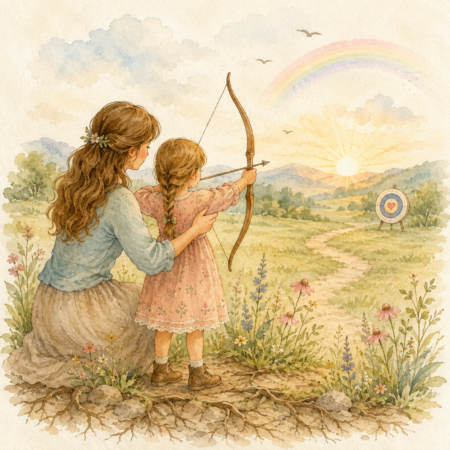
What Are We Aiming For? When I was learning how to drive a car, I developed a bad habit of looking at the road immediately in front of the hood. As I focused hard on the line to the left and the shoulder to the right, I ended up bouncing back and forth between the two, overcorrecting with micro adjustments constantly. The harder I focused, the more I weaved left and right, pin-balling between the lines – I couldn’t keep it steady. My dad taught me to lift my gaze up ahead, focusing farther down the road instead of right in front of the car. Amazingly, when I shifted my focus farther ahead and kept the lines in my peripheral vision instead, I held steady between them without looking directly at them. My dad taught me the value of focusing your eyes on where you’re headed, to hold steady on the way. Heart & Soul Too often as parents and homeschoolers, we develop the same bad habits. We focus on the milestones and the guidelines, overcorrecting this and micro-adjusting that, and (exhausted) we pinball down the road only looking at what is directly in front of us. “Following the guidelines” is not the destination. As parents, our “finish line” is much farther ahead. All of the milestones and guidelines are aiming us at that goal line (raising tiny people into full grown people) and THAT is where we must focus as we travel this road. We are aiming beyond the academics. We are aiming for their hearts and souls. Why I Homeschool First, what I’m **not** doing. I don’t homeschool because I didn’t have a good public school experience, or because I don’t like our local public school, out of fear, or out of pride. In fact, I had a great school experience, we have a wonderful local school system, I know that homeschooling doesn’t eliminate fear, and I’m too well aware of my faults to be too proud. Rather, I homeschool because the childhood years shape so much more than academics. And I don’t mean just the preschool and kindergarten years – I’m talking birth to adulthood. All the childhood years. Childhood is where so much of who we become begins to take shape. It’s where we learn how to work hard and how to rest, how to handle disappointment, how to treat people who frustrate us, how to see ourselves, how to make decisions, and what we believe is true and worth pursuing. It’s where character is practiced, values become convictions, and faith moves from something we’ve been told into something we have to wrestle with and eventually own for ourselves. What does the have to do with homeschooling? Everything. Now don’t get me wrong. I am NOT saying that publicly schooled kids won’t develop these skills, or their parents won’t be able to teach this things, or that homeschooling is the only way. What I AM saying is that character, heart, soul,.. these things are taught through a lot of time and proximity – and having your kids away at school all day only makes it more challenging. Not impossible, just harder. On the flip side: I am also NOT saying that homeschooling is easy, or makes training your kids hearts and minds easier. I’m only saying that it gives you more time and proximity. Homeschooling provides an opportunity to pour into your child’s education with more than simply academics. For me personally, I want more opportunities than what I would get at breakfast and dinner. One day my kids will move out (two of them already have) and I know that my one on one time is limited. I feel the clock ticking. The Real Reason I Homeschool Aim and release. In archery, the first thing an archer does is take his stance, planting his feet and positioning his body toward the target. He nocks the arrow and sets his grip — firm, but not too tight. He raises the bow, draws the string steadily, and finds his anchor: that familiar, consistent place he returns to each time he draws. Then he fixes his eyes on the target. He breathes. And he releases. Parenting feels a lot like that to me. We take our stance. We decide where we stand and what we believe. We hold our children firmly, but not so tightly that we forget they were never ours to control. We anchor ourselves again and again in the truths and values we want to pass down. And through all of the lessons and milestones and ordinary days, we keep our eyes on where we’re aiming. Because eventually, we release. That’s the real reason I homeschool. Not for targets or guidelines or goals. Not for test scores or perfection. I homeschool for my kids. For the precious years I have to teach them, know them, guide them, and prepare them for the day when my job is no longer to hold the bow. My legacy. My arrows. What are you aiming for?
Think You Are Behind on Homeschooling? Think Again.
You’re Not Behind There’s a quiet fear that sneaks in on homeschool moms — often unannounced, uninvited. We start feeling behind on homeschooling. It sounds like this: We should be doing more. Everyone else is ahead. What if I’m missing something important? . . . “IS MY CHILD BEHIND?” It usually shows up when you scroll.Or when someone casually mentions what their child can already do.Or when a birthday passes and the expectations feel heavier than they did last year. Dear one: You are not behind. The Myth of the Invisible Timeline Somewhere along the way, motherhood and education were assigned an invisible clock.A checklist that no one remembers agreeing to but everyone feels measured by. But children aren’t checklists. And learning is not a race with a starting gun. Especially in the early years. Especially with gentle homeschooling. The truth is: much of what we call “being behind” is simply being different. Different temperaments. Different seasons. Different needs. Different rhythms. Every child is different. Different is not deficient. Learning Happens in Layers, Not Lines Gentle learning doesn’t move in straight lines. It spirals. A child may: What looks like nothing happening is often deep internal work. There are roots growing. And don’t you know that roots always grow underground first? Presence Over Performance If your days include: You’re not wasting time. You’re building the very foundation that learning stands on. Children are naturally curious in their preschool and kindergarten years and they just need a guide. Your child needs you more than curriculum. Connection before content.Security before skill.Wonder before worksheets. This isn’t delay. This is beautiful by design. As the one who sets the pace and tempo and checkpoints for your home, you’re designing the learning environment piece by piece. Faithfulness Looks Small (and That’s Okay) Faithfulness in these years often looks unimpressive by the world’s standards. It looks like: The world often measures progress by quick results. Scripture reminds us that fruit grows slowly—and quietly. And it grows best when it’s rooted, not rushed. Tending your child’s heart and mind in the early years is a lot like growing fruit: slow and steady, with love and care, patience and time. Even the child who makes intuitive leaps quickly or grasps new concepts readily will only flourish all the more when given space to do so. If You Need a Reframe Today Here it is: You are not behind on homeschooling. You are growing, becoming, learning. Your child is unfolding, blossoming, reaching. Learning is happening in ways you won’t even fully recognize until later. Gentle education is not about getting ahead. It’s about staying aligned: with your child, your values, the season you’re in. So take a breath. release unnecessary expectations, and trust that God is at work in the slow, faithful days. You’re not behind on homeschooling. You’re just where you need to be. God bless.
Do I Need an Accredited Homeschool Curriculum?
Do I Need an Accredited Homeschool Curriculum? It’s back-to-school season, and I’ll be honest — I love it. The backpacks, the fresh pencils, the scent of new notebooks. I’m a sucker for pretty pens and crisp notepads with hopeful margins. Even after years of homeschooling, even with our curriculum already chosen, I still feel the siren call of shiny new books and whispered what-ifs. And if you’re just starting out, that pull can feel even stronger — especially when you start seeing terms like “accredited” homeschool curriculum floating around. It sounds official. Important. Maybe even required. But what does it really mean? And does it matter — especially if you’re homeschooling in Texas? Let’s talk about it. What Does “Accredited” Actually Mean? “Accredited” is one of those words that sounds very official — like a golden stamp of approval. But here’s the truth: accreditation isn’t a guarantee of quality, and it’s not even something homeschoolers are required to care about. In fact, it’s often misunderstood altogether. Accreditation is a voluntary process that applies to schools, not to individual families. It’s a way for a private or online school to say, “We meet the standards of a particular organization.” That organization — not a government agency — sets the benchmarks and decides what “counts.” Here’s what most people don’t realize:– A homeschool curriculum itself is not accredited. It’s the school or program that uses the curriculum that might be.– These standards are designed for institutions — not the gentle rhythm of a family learning together at the kitchen table. So if you see a homeschool curriculum advertising that it’s “accredited,” what they often mean is: We are part of (or offer enrollment through) an accredited private school program. Which is great… if you’re looking to outsource your homeschool to someone else. But if you’re planning to teach your child yourself, you don’t need that layer of oversight. Who Accredits These Programs — and What Are They Looking For? Accreditation isn’t handled by the government. It comes from private organizations — like Cognia, ACSI, or NCPSA — that review schools and programs based on their own standards. Those standards usually focus on things like:– Curriculum alignment with state standards– Recordkeeping and grading– Teacher qualifications– Testing and assessments It’s all designed for institutions — schools with classrooms, administrators, and report cards. These accrediting bodies aren’t elected, public, or parent-driven. They exist because some programs choose to submit to their system — not because they hold any real authority over you as a homeschooler. Accreditation tells you how a school operates — not how well it will serve your child at home. What Texas Law Actually Says About Homeschooling If you’re homeschooling in Texas, you are not required to use an accredited program. You’re not required to register with the state, submit test scores, or report attendance. In fact, you’re legally recognized as a private school — with full authority to choose how and what your child learns. This freedom comes from the landmark 1994 court case Leeper v. Arlington ISD, which ruled that Texas homeschools qualify as private schools as long as:– You teach in a bona fide (genuine) manner– You use a written curriculum– You cover five subjects: reading, spelling, grammar, math, and good citizenship That’s it. No licenses. No approval. No outside oversight. And definitely no requirement for accreditation. Private schools in Texas — including homeschools — are not subject to accreditation laws. It’s completely optional, and most homeschooling families choose not to pursue it because they don’t need to. You have full authority under Texas law to decide what counts as school. And that freedom is powerful. Why Accreditation Doesn’t Automatically Mean Better It’s easy to assume that “accredited” means safer, stronger, or more trustworthy. But when it comes to homeschool curriculum, that’s not always the case. In reality, accredited programs often come with:– Higher costs– Less flexibility– Standardized pacing that may not fit your child– Heavy testing or grading requirements– A one-size-fits-all structure Some families do well with those systems — especially in the high school years. But many younger learners (and their parents!) find them overwhelming, rigid, or just not a good fit. Accreditation doesn’t make a curriculum better. It just means it’s been reviewed by a particular organization for a particular purpose. The real question isn’t “Is it accredited?” It’s: “Does this help my child grow in wonder, wisdom, and confidence?” When Accreditation *Might* Matter To be honest? In over 20 years of homeschooling, I’ve never personally known another homeschool family who cared whether a program or curriculum was accredited. We all did the same thing:– Taught our kids using the materials that fit them best– Adjusted when something didn’t work– Created our own transcripts– Helped our teens prep for the SAT, ACT, or placement exams And our kids got into college. Colleges don’t ask, “Was your curriculum accredited?” They ask, “Can this student succeed here?” There are a few rare cases where accreditation might matter:– Re-enrolling in public school midstream– NCAA athletic eligibility But even then — there are usually workarounds. For most families, especially in Texas, accreditation just isn’t necessary. What I Look for Instead I’ve never once chosen a homeschool curriculum because it was accredited. Not once. Instead, I look for the things that actually matter in the day-to-day:– What does it teach — and how does it teach it?– Who created it — and what worldview does it reflect?– Is it adaptable? Flexible? Gentle? Challenging?– Does it make sense for my child and our rhythm?– Will it support comprehension — not just completion? These are the questions that have shaped our homeschool. Not whether someone else thinks a curriculum “counts,” but whether it works — for us. You don’t need a seal of approval to follow the Holy Spirit’s leading. You don’t need outside validation to watch your child come alive with understanding. And neither do you. “But What If My Child Falls Behind?” No grades? No report cards? No formal oversight?