
Which Letters to Teach First For Reading: One Gentle Approach
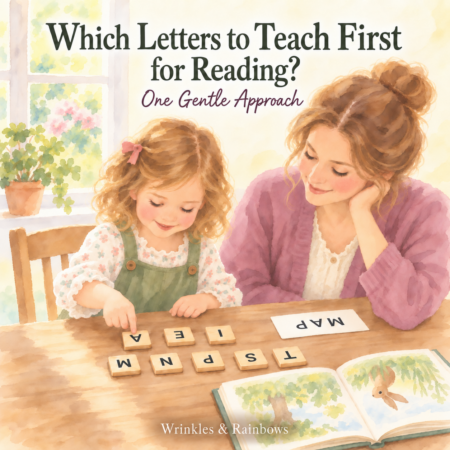
There’s no universal prescription for which letters to teach first when teaching preschoolers to read. Each reading curriculum follows its own path. In my post about teaching phonics to preschoolers, I mentioned that one gentle approach is starting with a small group of high-frequency, high-return letters—letters regularly encountered in beginning reading words that work together to form many simple words. Why start with a small list of letters? The National Center on Improving Literacy similarly recommends beginning with high-utility letter-sound relationships so children can begin working with words as quickly as possible. Starting small provides a solid foundation for further growth. Caveat: This is of course referring to the learning step AFTER your child knows all 26 letters of the alphabet, and knows their basic sounds. Teaching the alphabet is Step One. So. Which Letters to Teach First? Meet “The First Eight” Let me introduce you to a gentle teaching tool, a free download called The First Eight. This set uses the following eight, common, high-frequency, high-utility letters: a, e, i, m, n, p, s, and t. Together, these three short vowels and five consonants can be recombined to build 24 simple consonant-vowel-consonant words. There are even more possible combinations, but we begin with 24 real, approachable words. Why these eight? The three short sounds (short a, short e, and short i) immediately open the door into three short vowel groups. Adding the additional five consonants introduces eight different CVC word families: -an, -ap, -at, -en, -et, -in, -ip, and -it. (And more when you move into the Gentle Phonics series.) The 24 CVC words taught with these letters are as follows. Short A CVC Words List Short E CVC Words List: Short I CVC Words List: How to Introduce The First Eight Gently Using the philosophy from “Teaching Phonics to Preschoolers,” begin with introducing and modeling the letter combinations without pressure. Using physical activity or hands on manipulatives, ask your child to copy and reproduce the words sounds and combine them together. When they’re ready, ask them to start making words with the letters themselves. Tracing and writing are added when their hands are ready. Begin With a Few Words. Choose 3-4 cards from one family, such as mat, sat, and pat. Model Before Expecting. Introduce the cards, spell the words, sound them out, say them. Build the Words. Use tiles, magnetic letters, or alphabet clips to build and sound out the words on the card. Building words with physical letters allows practice when handwriting isn’t ready. Play Copycat. Ask your child to copy the sounds you say and build the words you build. Turn Learning Into Play. Play “Word Hunt” by laying a handful of cards on the table and your child to find one of them, or putting cards on the floor and asking your child to jump onto the right one. Trace or Write the Words – When Ready. When their little hands are ready, they can work on writing the word, sounding it out, and saying it, in one smooth process. Sheet protectors and dry erase markers can be used for reusable practice. Know When to Pause. Frustration is information – a sign that your child’s brain needs a break. It does’t help to push learning once a child is frustrated. Remember: learning is a rhythm, not a race. What if my child isn’t blending yet? Blending two sounds together is a completely different skill than recognizing a letter and knowing a sound it makes. This is a new skill! If your child is struggling to get from m-a-t to mat, don’t worry. What can you do to help? It can be helpful to go back to modeling. Slowly blend sounds together and “mash them” into the word to demonstrate. Ask your child to listen while you do it, and then copy it back. Reduce the workload to a few words and play games with them. Be silly. Pretend to be a slow motion robot stringing one sound into the next. Keep it light until it clicks. Once your child is ready, add more similar words and watch the understanding bloom. Download The First Eight for Free
Our Play-Based Nature-Rich Preschool Plan
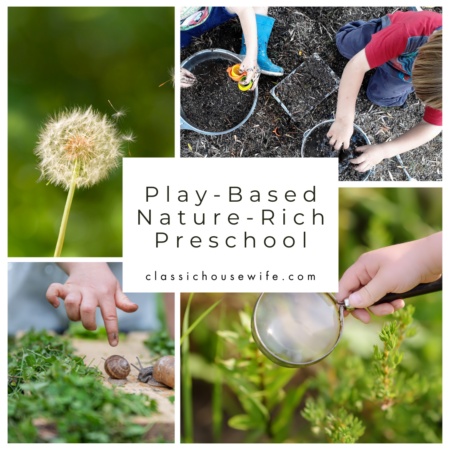
After so many years of experience and several months of researching, I still don’t know what to call our preschool approach: “a little Montessori/Waldorf/Reggio with a lot of nature and play and reading?” That doesn’t exactly roll off the tongue. I’m going to have to settle (for now) with just “play-based nature-rich preschool.” I think that about does it. Whatever it’s “called” doesn’t matter anyway, (and honestly it’s only very slightly different than what we have been doing for the past couple of years already.) =) I’ve been using seasonal and holiday themed sensory bins, invitations to play, and colorful books from season to season and holiday to holiday since our little Mouse was just a wee toddler. As I’ve said, in these first few years, kids are constantly learning and absorbing anyway – all you need to do is provide plenty of opportunities! That said, I do want to introduce a little more structure in our environment for our first real preschool year, to guide us in a flow through the year. And to that end, I’ve compiled a set of unit-study-like themes for each month of the school year, around which to create our sensory bins, invitations to play, read-alouds, and field trips, Meanwhile I want to provide plenty of play, exploration, and time outside as allowable. Play-Based Nature-Rich Preschool Themes for the Year: Mapping Out the Preschool Plan for Each Month After brainstorming topics for each month, the next step was a simple “no brainer” for me. Using lists of time tested read aloud books, book lists from Five in a Row and lists of Caldecott award winners, I began compiling a monthly list of theme-related read aloud books as well as an additional read aloud goal list for the whole year. Using my teacher discount at Thriftbooks.com and searching for deal items, I ordered a stack of books to get our school year started. We will have library days every Tuesday afternoon and try to find many of the books from our list that way. For everything else, there’s Amazon. 😉 In addition to reading lists, I plotted out a handful of weather appropriate and theme-related activities for the month. For example, we don’t live in an area with apple orchards (sadly–I looked!) But we found a friend with a pear tree and we picked some pears instead. We will be making pear butter with those pears today! And lastly, I’ve been working on Pinterest boards with hands on activities, crafts, projects, sensory bins, games, and experiments. Lil Miss Mouse LOVES doing things with her hands. She literally asks to do crafts EVERY SINGLE DAY. Crafts and projects are fun, and learning should be fun, so learning includes crafts and projects. It’s “preschooler math.” 😉 The Three R’s? What about the reading, writing, and arithmetic? She will definitely be learning to read, count, and write, but that will be scattered naturally throughout everything we do. I do have some additional practice worksheets I’ve made for her that we will use to provide some focused attention on these skills, but most of the learning will happen more spontaneously as we do everything else. From previous experience, I know that she will learn to read when she’s ready and not until she’s ready, so my approach for preschool is to provide opportunities without demand. I don’t want her to become resistant to reading and writing. Also, little hands are often still busy learning the skills necessary for writing, so a lot of the learning that does happen will be done verbally or with manipulatives with plenty of fun and games. There’s no rush! Putting our Play-Based Preschool Into Action It’s been a LONG time since I’ve had a preschooler, but I remember that our focused “preschool time” only took about 30 minutes a day. However, never before have I had an only child! There are no siblings to send her off to play with (and she wants to play all day long!) Just a little bit of structure and planning will help with both of those. The structure and planning: daily read aloud and activity at 10am, library days and gymnastics on Tuesday afternoons, play dates and/or park days on Wednesday mornings, homeschool co-op on Thursdays, babysitter days every other week, and monthly field trips. Also: sensory bins, loose parts, and invitations to play rotated weekly. She and I also started making handmade items from our garden and foraged things this past spring (such as rose petal sugar scrub, dandelion jelly, and wildflower seed bombs.) We have sunflower jelly, sunflower lemon sugar scrub, salted caramel pear butter, and handmade cards planned for this month so that will keep us busy a lot, too. I’ll share our monthly unit-study-like plans in more detail later, as well as our handmade projects as we make them. Follow along and learn along with us, too. **Take this homeschool style quiz to learn more about your own style. My top three were, not surprisingly, unschooler, unit study, and Charlotte Mason (but then Montessori and What is Waldorf Homeschooling? – Homeschool Plus and Reggio Emilia weren’t options.) 😉 Subscribe to Posts Signup for new updates and special offers and receive the Pre-K Letters Pack for free! Subscribe Loading… Thank you! You have successfully joined our subscriber list.
My Preschool Homeschool Do’s and Don’ts
The first time I started homeschooling a preschooler, I was 24 with a three-year-old and a newborn baby. Now THAT three-year-old is 24 with a newborn baby (true story.) Needless to say, a few things have changed between that first preschool homeschool adventure and now. Those early days of preschool were quite simple, focusing mainly on reading and math for 30 minutes a day, with a good amount of arts and crafts thrown in for my artsy-crafty child. But I also remember feeling like I needed to somehow recreate a public-school preschool setting. It didn’t take me long to realize that I didn’t need to act like a teacher because I had always been her teacher from the beginning. Twenty Years Later… So many things have changed in the last twenty years, but there’s plenty that hasn’t! I still want to make learning fun, I want to teach my kids *how* to learn so they can continue learning new things all life long, I want to teach to their interests, and I want to show them the wondrous works of God throughout the world. Of course, now “them” is just a “she” and it’s my first time schooling only one. On the other hand, I’ve learned a lot of things to do and not to do and I’ve got a good bit of hard-earned wisdom under my belt. I know there are a lot of things that look like learning which are actually busy work, that many things can wait until the child is ready, and that a large amount of learning happens through fun and play. Some Homeschooling Preschool “DO’s” A Few Preschool Homeschool “DON’Ts” Getting Ready for Preschool With the days on the August calendar flying by, odds are that you’re about to launch your school year soon–if you haven’t already. With all the daunting options, methods, and resources available to help you teach your preschooler, it can feel a little overwhelming. Just remember as you begin this new journey that what you do doesn’t matter as much as how you do it. Your kids will learn things no matter what you do, because that’s what young kids do! Present plenty of opportunities, lots of fun ways to learn things, and encourage the curiosity. Enjoy it! For us, I’ve spent the last month or so making a plan for our preschool year. I’ve purchased some books to read, made a list of books to find at the library, saved some crafts and projects on Pinterest, and I’ve even created some printables that I know she will enjoy! (Those are going in my store!) I’ve researched and found a co-op for finding and making friends, I’ve planned some field trips, and I’ve enrolled her in her second year of gymnastics (which she loves so much.) We officially begin next Monday, so wish me luck! 😉 I’ll be sharing more about our preschool plan in the next week or two. For the rest of August we will be studying “apples and seeds” (and other related things.) I’ll share more later. In the meantime, if you haven’t already read it, you can check out my post about what your child needs to learn in preschool.