
There’s no universal prescription for which letters to teach first when teaching preschoolers to read. Each reading curriculum follows its own path. In my post about teaching phonics to preschoolers, I mentioned that one gentle approach is starting with a small group of high-frequency, high-return letters—letters regularly encountered in beginning reading words that work together to form many simple words.
Why start with a small list of letters?
- The child is not juggling all 26 letters simultaneously.
- The same familiar sounds appear repeatedly.
- A carefully chosen set produces real words quickly.
- Reading a few genuine words gives the child an early sense of success.
The National Center on Improving Literacy similarly recommends beginning with high-utility letter-sound relationships so children can begin working with words as quickly as possible. Starting small provides a solid foundation for further growth.
Caveat: This is of course referring to the learning step AFTER your child knows all 26 letters of the alphabet, and knows their basic sounds. Teaching the alphabet is Step One.
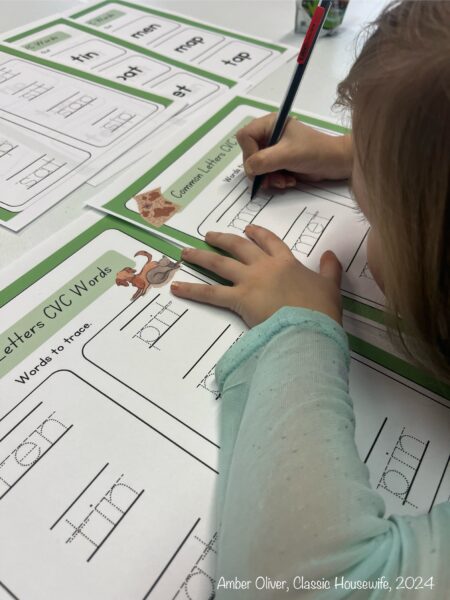
So. Which Letters to Teach First? Meet “The First Eight”
Let me introduce you to a gentle teaching tool, a free download called The First Eight. This set uses the following eight, common, high-frequency, high-utility letters: a, e, i, m, n, p, s, and t. Together, these three short vowels and five consonants can be recombined to build 24 simple consonant-vowel-consonant words. There are even more possible combinations, but we begin with 24 real, approachable words.
Why these eight?
The three short sounds (short a, short e, and short i) immediately open the door into three short vowel groups. Adding the additional five consonants introduces eight different CVC word families: -an, -ap, -at, -en, -et, -in, -ip, and -it. (And more when you move into the Gentle Phonics series.)
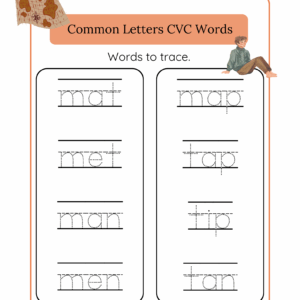
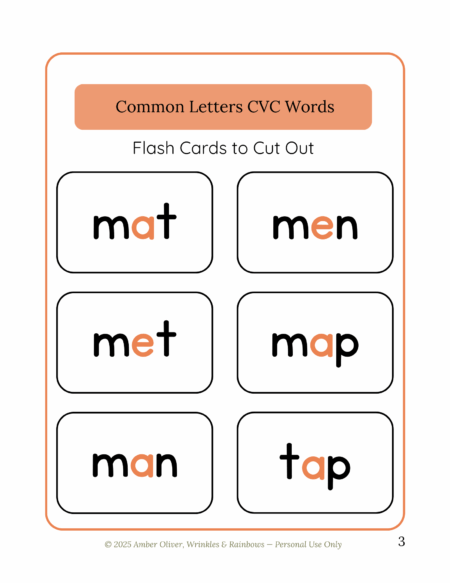
The 24 CVC words taught with these letters are as follows.
Short A CVC Words List
- mat, man, map
- tap, tan
- pat, pan
- nap
- sat, sap
Short E CVC Words List:
- met, men
- ten
- pet, pen
- net
- set
Short I CVC Words List:
- tip, tin
- pit, pin
- nip
- sip, sit
How to Introduce The First Eight Gently
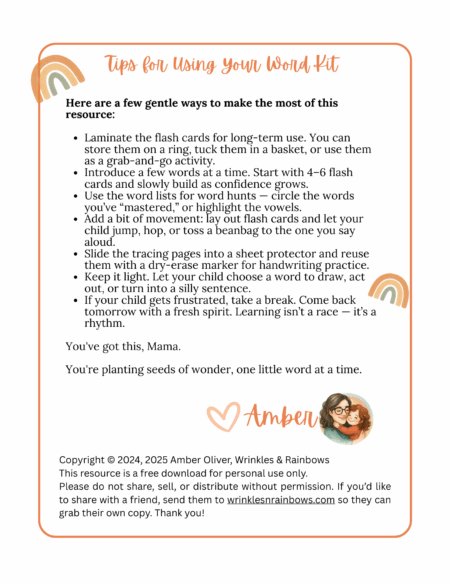
Using the philosophy from “Teaching Phonics to Preschoolers,” begin with introducing and modeling the letter combinations without pressure. Using physical activity or hands on manipulatives, ask your child to copy and reproduce the words sounds and combine them together. When they’re ready, ask them to start making words with the letters themselves. Tracing and writing are added when their hands are ready.
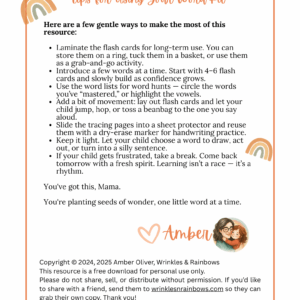
Begin With a Few Words. Choose 3-4 cards from one family, such as mat, sat, and pat.
Model Before Expecting. Introduce the cards, spell the words, sound them out, say them.
Build the Words. Use tiles, magnetic letters, or alphabet clips to build and sound out the words on the card. Building words with physical letters allows practice when handwriting isn’t ready.
Play Copycat. Ask your child to copy the sounds you say and build the words you build.
Turn Learning Into Play. Play “Word Hunt” by laying a handful of cards on the table and your child to find one of them, or putting cards on the floor and asking your child to jump onto the right one.
Trace or Write the Words – When Ready. When their little hands are ready, they can work on writing the word, sounding it out, and saying it, in one smooth process. Sheet protectors and dry erase markers can be used for reusable practice.
Know When to Pause. Frustration is information – a sign that your child’s brain needs a break. It does’t help to push learning once a child is frustrated. Remember: learning is a rhythm, not a race.
What if my child isn’t blending yet?
Blending two sounds together is a completely different skill than recognizing a letter and knowing a sound it makes. This is a new skill! If your child is struggling to get from m-a-t to mat, don’t worry. What can you do to help?
It can be helpful to go back to modeling. Slowly blend sounds together and “mash them” into the word to demonstrate. Ask your child to listen while you do it, and then copy it back. Reduce the workload to a few words and play games with them. Be silly. Pretend to be a slow motion robot stringing one sound into the next. Keep it light until it clicks.
Once your child is ready, add more similar words and watch the understanding bloom.
Download The First Eight for Free
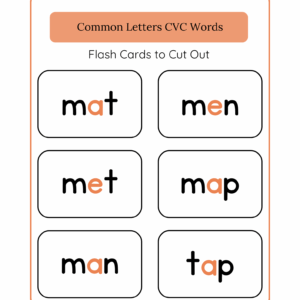
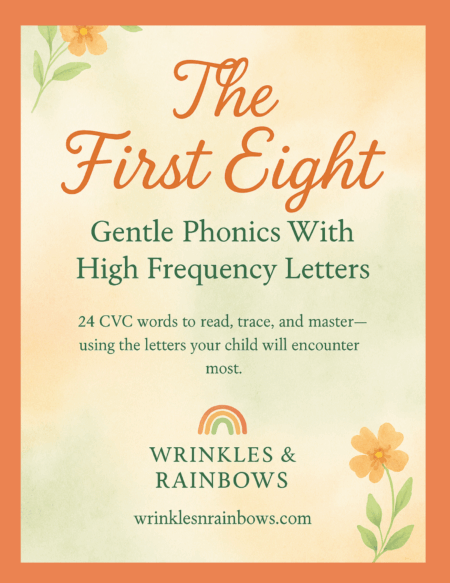
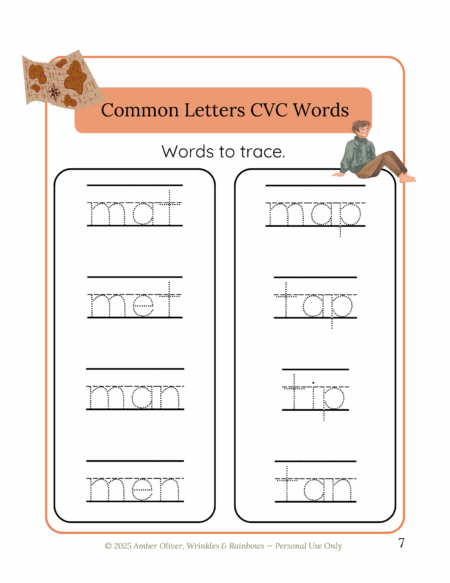
The First Eight Letters – Phonics For Preschoolers *Free Download*
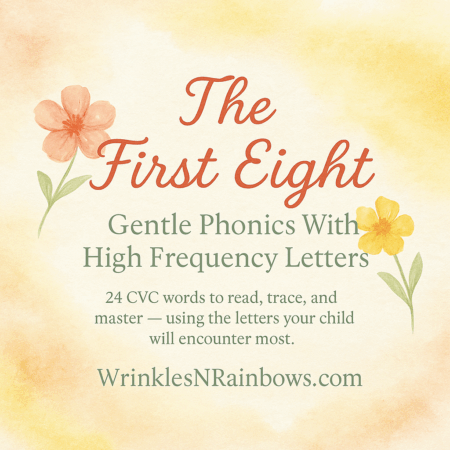
Gentle Phonics With High Frequency Letters – Free Download
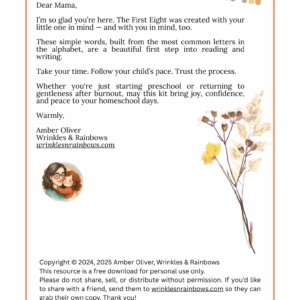
This free download features 24 simple, consonant-vowel-consonant (CVC) words built from the eight very commonly used letters when learning to read: A, E, I, M, N, P, S, and T.
It’s a beautiful, brain-friendly place to begin reading — created especially for preschoolers and early learners. Use these as a warm-up to reading lessons, independent practice, or a soft start to your homeschool day. This kit pairs wonderfully with dry-erase sleeves, scissors, and a cozy cup of tea.
Created with gentleness in mind, for mamas who love slow starts and simple tools.
From Wrinkles & Rainbows. Always free for personal use.







1 Comment
[…] your child already know the alphabet and its basic sounds?Continue with Which Letters Should Your Child Use First for Reading? and discover how eight carefully selected letters can help your child begin building and reading […]