
Which Letters to Teach First For Reading: One Gentle Approach
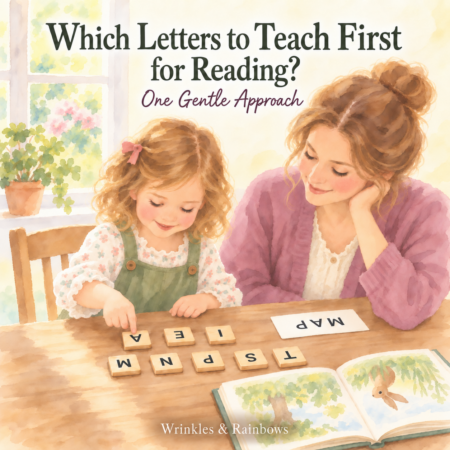
There’s no universal prescription for which letters to teach first when teaching preschoolers to read. Each reading curriculum follows its own path. In my post about teaching phonics to preschoolers, I mentioned that one gentle approach is starting with a small group of high-frequency, high-return letters—letters regularly encountered in beginning reading words that work together to form many simple words. Why start with a small list of letters? The National Center on Improving Literacy similarly recommends beginning with high-utility letter-sound relationships so children can begin working with words as quickly as possible. Starting small provides a solid foundation for further growth. Caveat: This is of course referring to the learning step AFTER your child knows all 26 letters of the alphabet, and knows their basic sounds. Teaching the alphabet is Step One. So. Which Letters to Teach First? Meet “The First Eight” Let me introduce you to a gentle teaching tool, a free download called The First Eight. This set uses the following eight, common, high-frequency, high-utility letters: a, e, i, m, n, p, s, and t. Together, these three short vowels and five consonants can be recombined to build 24 simple consonant-vowel-consonant words. There are even more possible combinations, but we begin with 24 real, approachable words. Why these eight? The three short sounds (short a, short e, and short i) immediately open the door into three short vowel groups. Adding the additional five consonants introduces eight different CVC word families: -an, -ap, -at, -en, -et, -in, -ip, and -it. (And more when you move into the Gentle Phonics series.) The 24 CVC words taught with these letters are as follows. Short A CVC Words List Short E CVC Words List: Short I CVC Words List: How to Introduce The First Eight Gently Using the philosophy from “Teaching Phonics to Preschoolers,” begin with introducing and modeling the letter combinations without pressure. Using physical activity or hands on manipulatives, ask your child to copy and reproduce the words sounds and combine them together. When they’re ready, ask them to start making words with the letters themselves. Tracing and writing are added when their hands are ready. Begin With a Few Words. Choose 3-4 cards from one family, such as mat, sat, and pat. Model Before Expecting. Introduce the cards, spell the words, sound them out, say them. Build the Words. Use tiles, magnetic letters, or alphabet clips to build and sound out the words on the card. Building words with physical letters allows practice when handwriting isn’t ready. Play Copycat. Ask your child to copy the sounds you say and build the words you build. Turn Learning Into Play. Play “Word Hunt” by laying a handful of cards on the table and your child to find one of them, or putting cards on the floor and asking your child to jump onto the right one. Trace or Write the Words – When Ready. When their little hands are ready, they can work on writing the word, sounding it out, and saying it, in one smooth process. Sheet protectors and dry erase markers can be used for reusable practice. Know When to Pause. Frustration is information – a sign that your child’s brain needs a break. It does’t help to push learning once a child is frustrated. Remember: learning is a rhythm, not a race. What if my child isn’t blending yet? Blending two sounds together is a completely different skill than recognizing a letter and knowing a sound it makes. This is a new skill! If your child is struggling to get from m-a-t to mat, don’t worry. What can you do to help? It can be helpful to go back to modeling. Slowly blend sounds together and “mash them” into the word to demonstrate. Ask your child to listen while you do it, and then copy it back. Reduce the workload to a few words and play games with them. Be silly. Pretend to be a slow motion robot stringing one sound into the next. Keep it light until it clicks. Once your child is ready, add more similar words and watch the understanding bloom. Download The First Eight for Free
Teaching Phonics to Preschoolers: Is Your Child Ready?
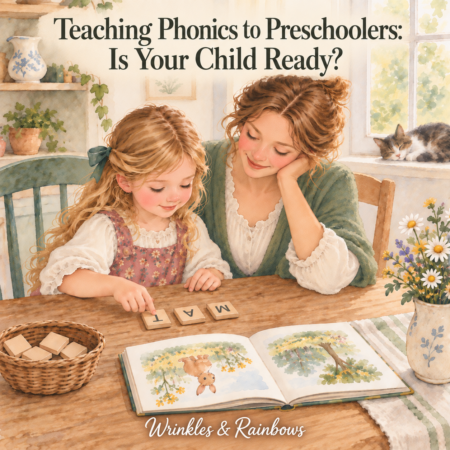
Teaching phonics to preschoolers: Is your child ready? That isn’t a one-size-fits-all question. (Sorry.) Some preschoolers are eager to begin sounding out words, while others need more time to play with letters and become familiar with their sounds—and that’s perfectly okay. Before we talk about readiness, it helps to distinguish between learning the alphabet and learning phonics. Learning the alphabet begins with recognizing and naming letters and becoming familiar with the sounds they commonly represent. Phonics takes that knowledge one step further: it teaches children how the sounds of spoken language connect to written letters, and how those letters and sounds work together to form words. In other words, knowing the alphabet lays the foundation. Phonics helps a child begin turning those familiar letters into words they can actually read. Let’s Start At the Very Beginning (Humming the “Do-Re-Mi” song…) Before children can use letters to build and read words, they need a growing familiarity with the alphabet. This usually begins very naturally: singing the alphabet song, playing with magnetic letters, matching letters to pictures, noticing letters in books and signs, and learning the sounds they commonly make. Some children become fascinated with letters very young. Others aren’t interested until later. Both are perfectly normal. Story time: When my third child was two, he began recognizing and writing letters. By the time he was four, he was reading some simple three-letter CVC words. With two older sisters to watch, he seemed to pick it all up very quickly. But just as quickly as he started, he stopped. He was no longer interested. So we switched from Hare Mode to Tortoise Mode. Instead of pushing forward simply because he had shown that he could, we slowed down and waited. A couple of years later, he was ready to begin making progress again. That experience taught me something important: being able to recognize letters or sound out a few words doesn’t always mean a child is ready for regular reading instruction. Knowing the alphabet is an important foundation, but readiness also involves interest, attention, memory, and the developmental ability to begin connecting sounds into words. So how can you tell when your child is truly ready? Ready, Set, Go! There isn’t one particular age—or one perfect readiness test—that tells you when to begin teaching phonics. Instead, look for a growing collection of readiness signs that your child is becoming ready to connect spoken sounds with written letters. You may notice: Your child doesn’t need to demonstrate every sign perfectly before you begin. These are simply clues that it may be time to test the waters with a few playful phonics activities. Follow their response. If they are curious and enjoying themselves, continue gently. If they become frustrated, resistant, or uninterested, take a break and try again later. There is no prize for beginning early—and no failure in waiting until your child is truly ready. Okay, My Preschooler Seems Ready to Read, So Now What? Yay! Now we get to the fun part. Teaching a child to read can be wonderfully rewarding. Watching that little light bulb come on when a child realizes that the marks on the page form a word is a beautiful thing. It can also be frustrating sometimes. There are so many programs, methods, opinions, and lists of things your child is supposedly meant to know. It’s understandable if teaching reading feels a bit daunting at first. The first thing I want you to remember is this: you do not have to find one perfect program or teach every skill at once. There are different ways to organize phonics instruction, but a good beginning will help your child connect letters with sounds, blend those sounds together, and gradually read simple words. Children learn those skills at different rates, and you are not on a deadline. Begin by noticing which stage your child is in: The second thing I encourage you to do is spend plenty of time reading aloud together—not only as a lesson, but simply for the joy of sharing good books. Reading aloud builds vocabulary, understanding, imagination, and a love of stories, while phonics instruction teaches children how to decode the words for themselves. Young children need both. As they begin learning letters and words, they’ll delight in recognizing them inside the favorite stories you have read together again and again. When you’re ready to begin, keep the lessons short, concrete, and playful. Here are three gentle ways to practice phonics with your preschooler. Three Gentle Methods For Teaching Phonics to Preschoolers 1. Use Letters Your Child Can Touch and Move A small collection of physical letters can be used from the earliest days of alphabet play through the beginning stages of reading. Magnetic letters, wooden letters, alphabet puzzles, letter tiles, and even handmade paper letters all work beautifully. While your child is learning the alphabet, use the letters to practice recognizing, naming, matching, and sorting them. Once your child knows the letters and their basic sounds, use those same pieces to begin building simple words. For example, you might place M-A-T in a row, point to each letter as you make its sound, and then slowly blend the sounds together: /m/ /ă/ /t/—mat. Your child can watch first, then begin joining you when they are ready. I began collecting inexpensive letter toys when my youngest, Millie, started recognizing letters. We used magnetic letters, wooden alphabet puzzles, and other hands-on pieces. One of our favorites was a set of wooden letter-and-flashcard puzzles. Each letter fit into its matching card only one way, making the activity both hands-on and self-correcting. Movable letters are especially helpful for young children because reading and writing do not have to develop at exactly the same pace. A child who isn’t ready to write words independently can still choose letters, arrange them in order, touch each sound, and experience the satisfaction of building a word. 2. Turn Practice Into a Matching Game Matching is a simple way to practice letters and sounds without making the activity feel like a lesson—or a quiz. Begin with the kind of matching your